Article · 8 minutes
Why I Built Joys & Woes: A Private Place for the Days We Forget
The personal ritual behind Joys & Woes, and why I built this iPhone journal to be local-first, private, exportable, and useful without sharing your life online.

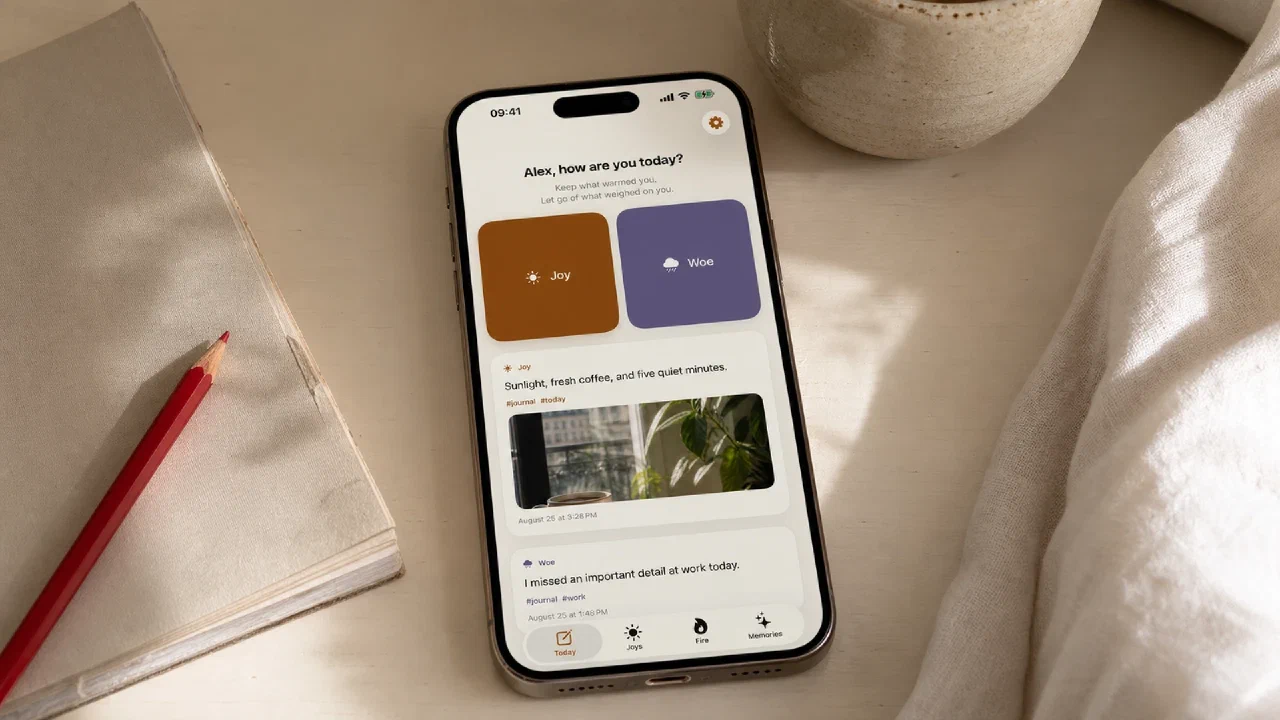
I do not think every meaningful moment needs an audience. Some things are worth remembering precisely because they remain yours. That belief became Joys & Woes: a small, private iPhone journal for keeping what felt good and letting go of what did not.
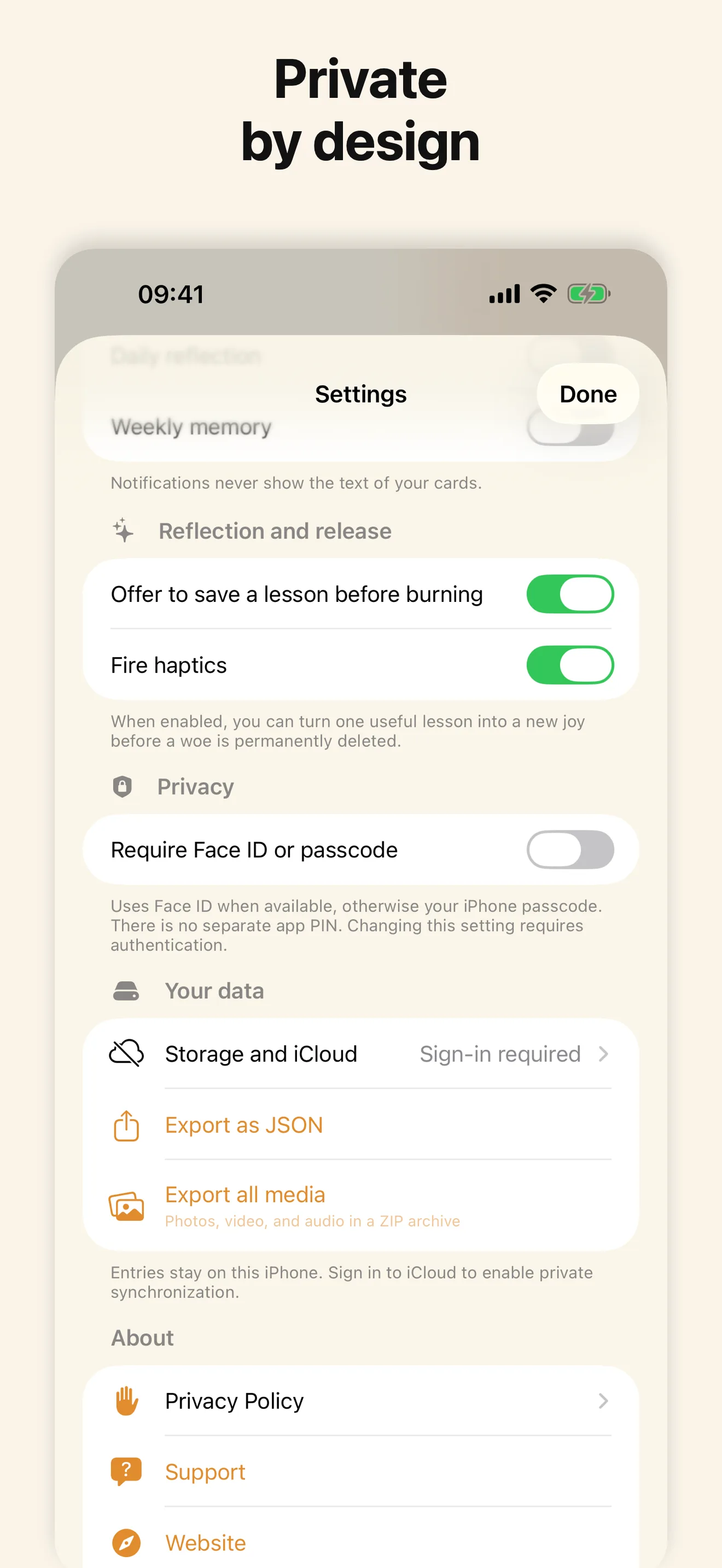
It is built the way I want personal software to work. You can use it without an account, without a developer-owned server, and without an internet connection. The journal can stay on your iPhone, you can export your entries as JSON and your media as an archive, and iCloud is there only if you choose to use it for continuity across your own devices.
But the app did not begin with a privacy checklist. It began with a ritual I had almost forgotten.
We Build Our Days Out of Rituals
Some rituals are so ordinary that we barely notice them. We brush our teeth in the morning. We make coffee in the same cup. We close the laptop before leaving work.
Other rituals are collective. A team has a daily stand-up, a weekly planning session, or a Friday review. The format may be repetitive, but repetition is the point: it creates a place and a time for something that would otherwise be postponed.
Personal life has rituals too. They do not need to be solemn or spiritual. A ritual can simply be a small repeated action that says: this deserves my attention.
Years ago, my former girlfriend and I had one of those rituals. We called it Joys & Woes-the same name the app uses today. We would tell each other what had felt good and what had felt bad. It was simple, a little playful, and surprisingly useful. The day stopped being a single verdict - good or bad - and became a collection of moments we could notice separately.
The relationship ended, and eventually the ritual disappeared from my life as well. Much later, I remembered it for a completely different reason.
When Weeks Become Months
I have kept personal journals for a long time. Most often I used Microsoft OneNote. One reason was practical: I liked having a local file, a thing I could keep, back up, and move. The tool mattered less than the feeling that the record belonged to me.
I once told my friend Alexey about this habit. He said that weeks blur into months, months into years, and it can seem as though nothing much changes.
That sentence stayed with me because it is both wrong and emotionally accurate.
A great deal happens every day. Someone sends a kind message. You finish a difficult piece of work. The light is good during an evening walk. A cat does something ridiculous. Dinner turns out better than expected. None of these moments needs to become an achievement, and none of them has to be important enough for a public post. Yet together they are the texture of a life.
When we do not record them, the days can flatten into a vague summary. When we do, even briefly, we leave small doors back into our own past.
Not Every Memory Needs to Become Content
Social networks offer a familiar answer to memory: share it. Publish the photo, turn the thought into a Story, wait for a reaction, and let the platform remind you of it later.
Sometimes that is exactly what we want. But sharing and remembering are different actions.
A private memory does not need to be shaped for an audience. It can be trivial, unfinished, embarrassing, tender, or meaningful only to you. It does not need a caption that makes sense to strangers. It does not need likes to prove that it mattered.
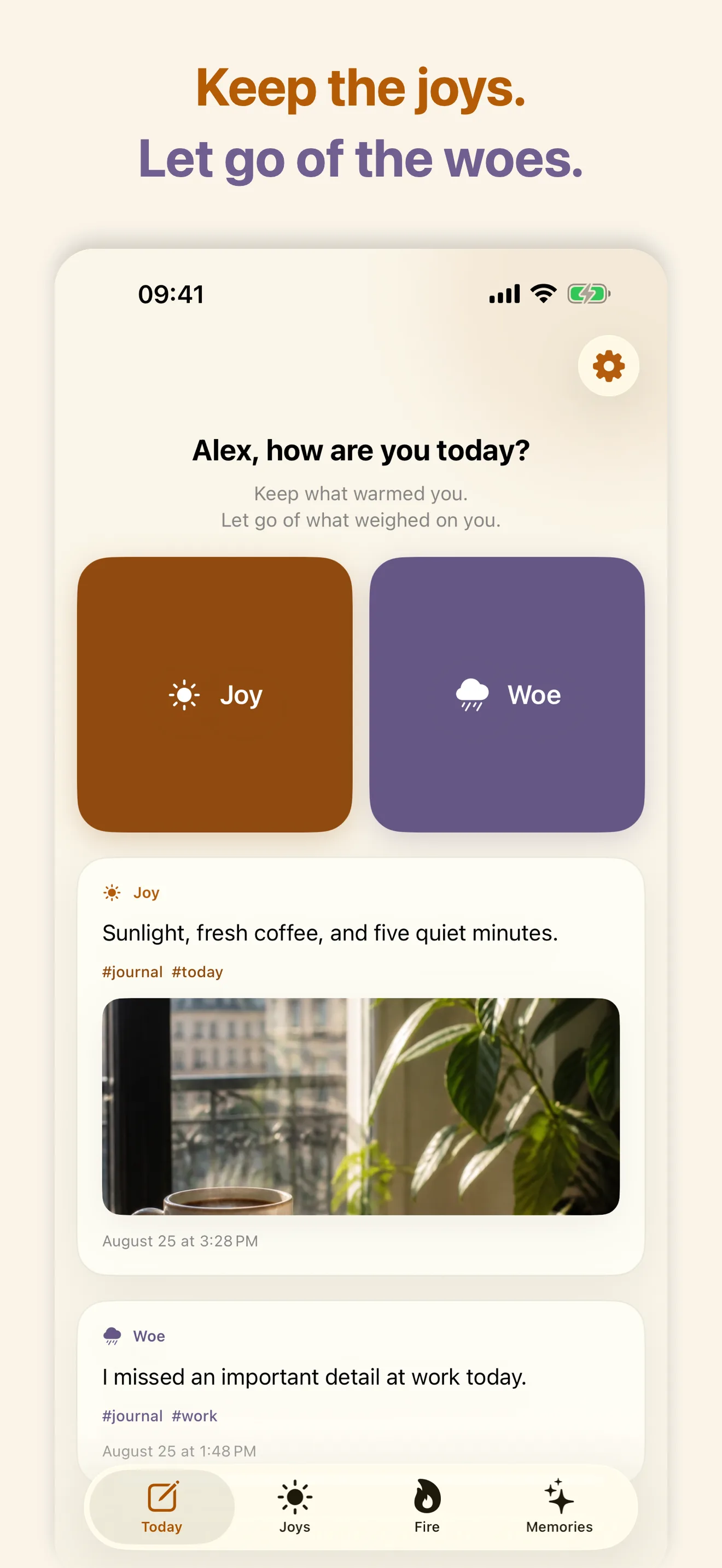
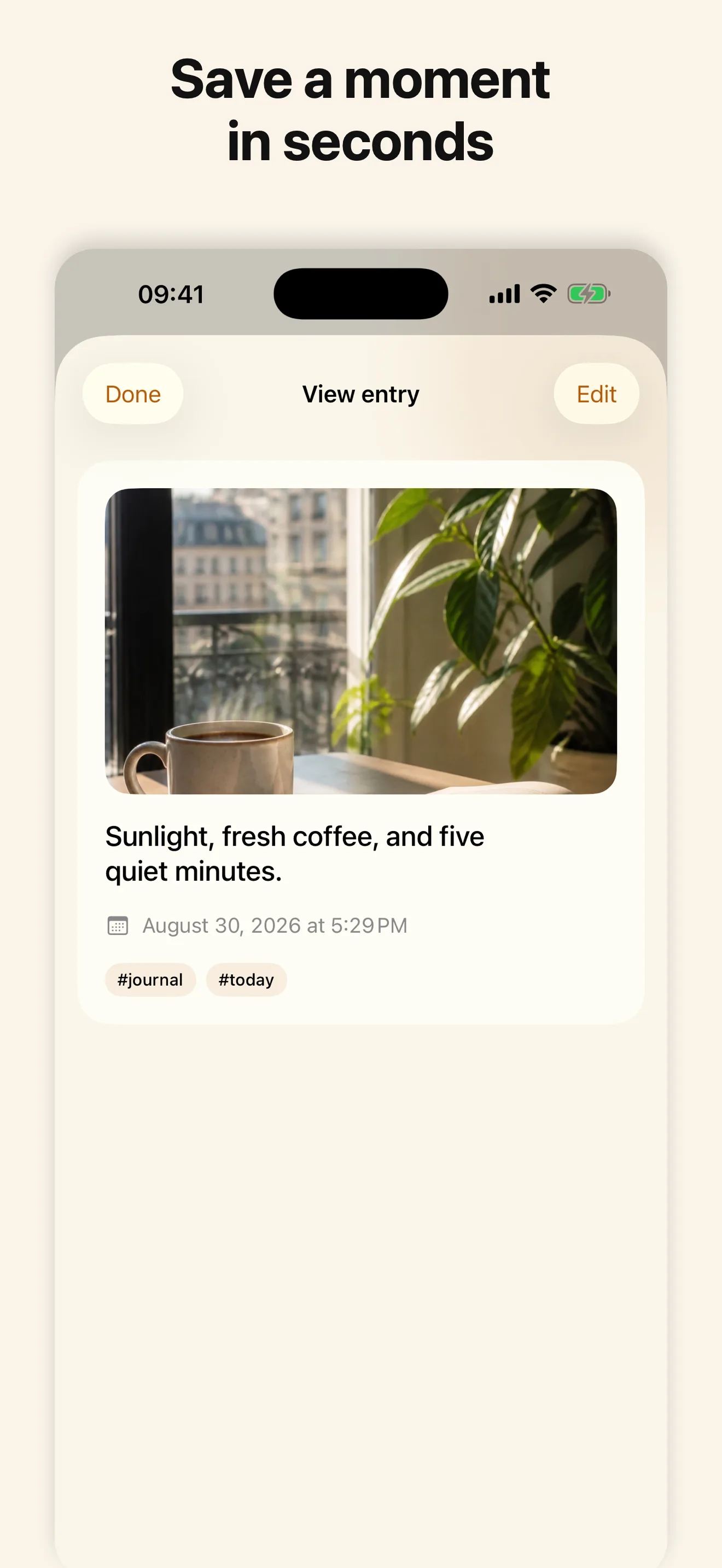
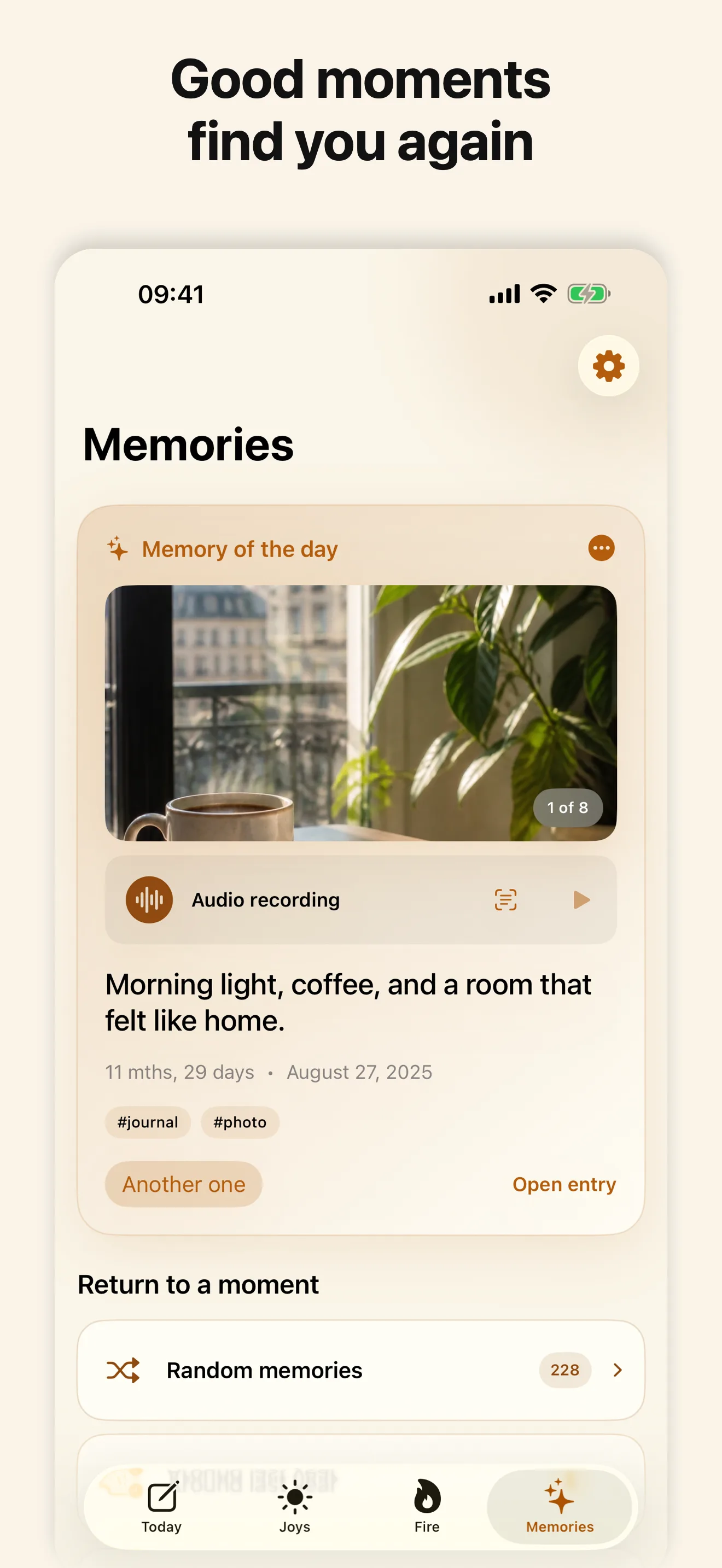
That became the first half of the app: keep the joys. Write a sentence in a few seconds. Add a photo, video, audio recording, or tags if they help. Let good moments return later through Memories - not because an algorithm wants more engagement, but because you chose to save them.
The Other Half Is About Letting Go
I did not want to build a vault that keeps every difficult feeling forever.
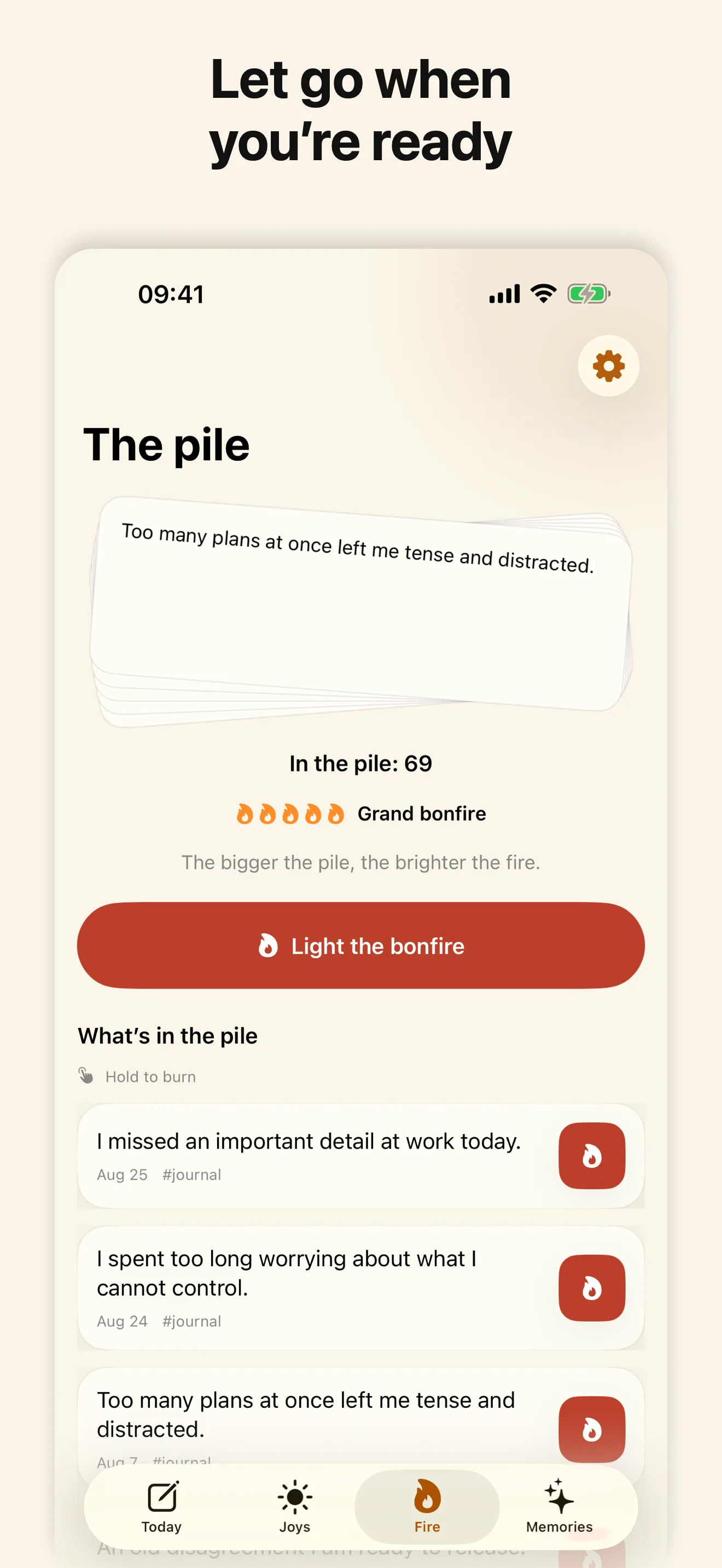
Some bad experiences contain a useful lesson. Others are only weight. Joys & Woes lets you write them down, keep them for as long as you need, and then burn the card when you are ready. If a lesson is worth carrying forward, you can preserve that lesson as a new joy before the original entry disappears.
The fire is intentionally symbolic. There is some research behind the broader idea of giving thoughts a physical form and then discarding that representation. In one series of experiments, people who wrote thoughts on paper and physically threw the paper away relied on those thoughts less in later judgments than people who kept the paper. The authors were careful about the scope of the result: the action changed how much weight participants gave the thoughts; it did not prove a general treatment for distress.
The study was published as “Treating Thoughts as Material Objects Can Increase or Decrease Their Impact on Evaluation,” by Pablo Briñol, Margarita Gascó, Richard E. Petty, and Javier Horcajo, in Psychological Science, volume 24, issue 1, 2013, pages 41-47.
Another paper, “Rituals Alleviate Grieving for Loved Ones, Lovers, and Lotteries,” by Michael I. Norton and Francesca Gino, reported experiments in which rituals after a loss reduced grief partly by restoring a sense of control. It appeared in the Journal of Experimental Psychology: General, volume 143, issue 1, 2014, pages 266-272. But a digital bonfire is not the same as those experiments, and Joys & Woes is not therapy. It does not promise to treat anxiety, depression, grief, or trauma.
The reason for the ritual is simpler: pressing Delete feels administrative. Holding a card, watching it burn, and knowing there is no trash or undo makes the decision deliberate. The animation does not erase what happened. It marks the moment when you decide not to keep carrying its record inside the app.
Private Means Local First
The story of the app is personal, so its architecture had to respect personal boundaries.
I dislike the default assumption that every piece of software needs an account and that every private note should be stored in somebody else’s database. A journal may contain the most intimate material a person ever writes. “Trust us” is not a sufficient product feature.
Joys & Woes therefore starts with a different set of constraints:
- no app account;
- no developer-owned backend for journal entries;
- no advertising or analytics SDK;
- full use without an internet connection;
- local storage on the iPhone as a real choice, not a degraded mode;
- optional protection with Face ID or the device passcode;
- JSON export and a separate media archive under the user’s control;
- iCloud storage only as an option, through the user’s private iCloud database, when syncing across their own devices is worth it.
This does not make the phone magical or remove the need for backups. Local data can still be lost with a device. iCloud introduces Apple’s infrastructure into the picture. Privacy is not a slogan that eliminates trade-offs; it is the practice of making those trade-offs visible and giving the person a meaningful choice.
A Journal Without a Score
I also did not want another system that turns self-reflection into performance.
There are no emotional scores to optimize. There is no public feed. There is no required daily streak and no punishment for missing a day. A reminder can help establish a ritual, but the ritual should serve the person - not the other way around.
The app is intentionally small:
- Notice something good and keep it.
- Notice something difficult and give it words.
- Return to the good moments sometimes.
- Release the difficult record when you are ready.
- Keep a lesson only if it is genuinely useful.
That is all I wanted from the original ritual, translated into software.
The Days Were Not Empty
Alexey was right about the feeling: weeks do become months, and months become years with alarming speed. But the conclusion does not have to be that nothing happened.
The small moments were there. We simply did not always give them a place to remain.
Joys & Woes is my attempt to create that place without turning private life into public content and without asking a remote service to remember everything on my behalf. It keeps the good close, gives the difficult a deliberate exit, and leaves ownership of the record where I believe it belongs: with the person who lived it.
You can read more on the Joys & Woes product page or download it from the App Store.
Continue exploring
Related reading
Why I Rebuilt My Page Monitor Without a Server
Why I moved my page checks from my own servers and bots to a small TypeScript monitor running in GitHub Actions.

Search Clues: My First Pass at an Organic Traffic Drop
A practical, private first pass at falling organic traffic: export Search Console data, compare confirmed Google updates and site changes, and keep several sites' history in your own browser.

Why I Built GoalLane: Doing Less, Moving Toward Something
Why I built GoalLane as a private, goal-first iPhone planner: short horizons, a few clear outcomes, realistic daily capacity, and steps that lead somewhere.