Article · 7 minutes
Why I Built GoalLane: Doing Less, Moving Toward Something
Why I built GoalLane as a private, goal-first iPhone planner: short horizons, a few clear outcomes, realistic daily capacity, and steps that lead somewhere.

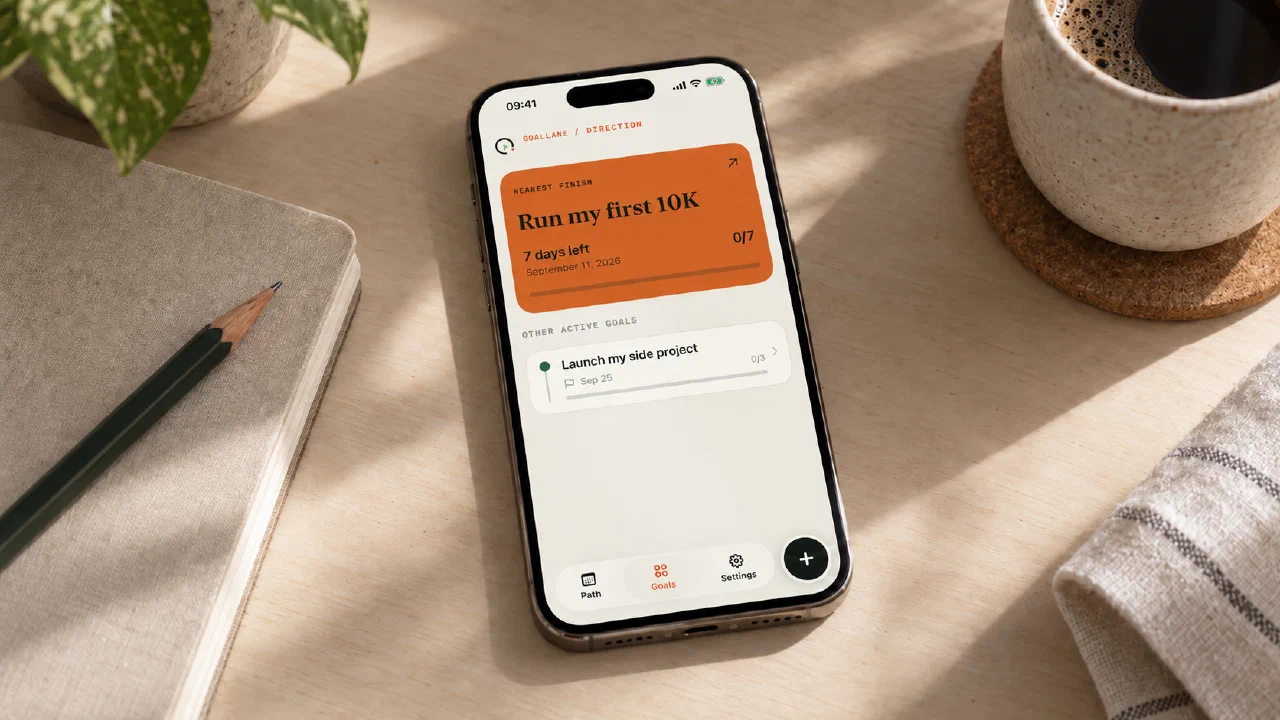
I have often met people who are busy from morning to night and still feel they have made no progress. I know the feeling myself: a long list gets shorter, messages are answered, little jobs are done, and yet the thing that mattered at the beginning of the week has not moved.
It is not necessarily a problem of effort. Sometimes the list simply has no destination. GoalLane is my attempt to turn that question around: first decide what result you want, then give the days leading up to it a small number of concrete steps.
I am not offering an app that tells anyone what their life should be about. I am building a place for the nearer, more answerable question: what can I actually finish in the next two weeks or month?
A Full Day Is Not the Same as Progress
A to-do list is good at remembering things. It is less good at asking whether those things add up to anything. I can clear an inbox, make an appointment, fix a minor detail, and still avoid the one uncertain step that would move a project forward.
I have seen this in other people’s work and in my own: plenty of activity, very little return on the effort. This is not an accusation that everyday maintenance is worthless. Some work has to be done just to keep life running. But if every item has the same visual weight, it becomes hard to tell maintenance from movement.
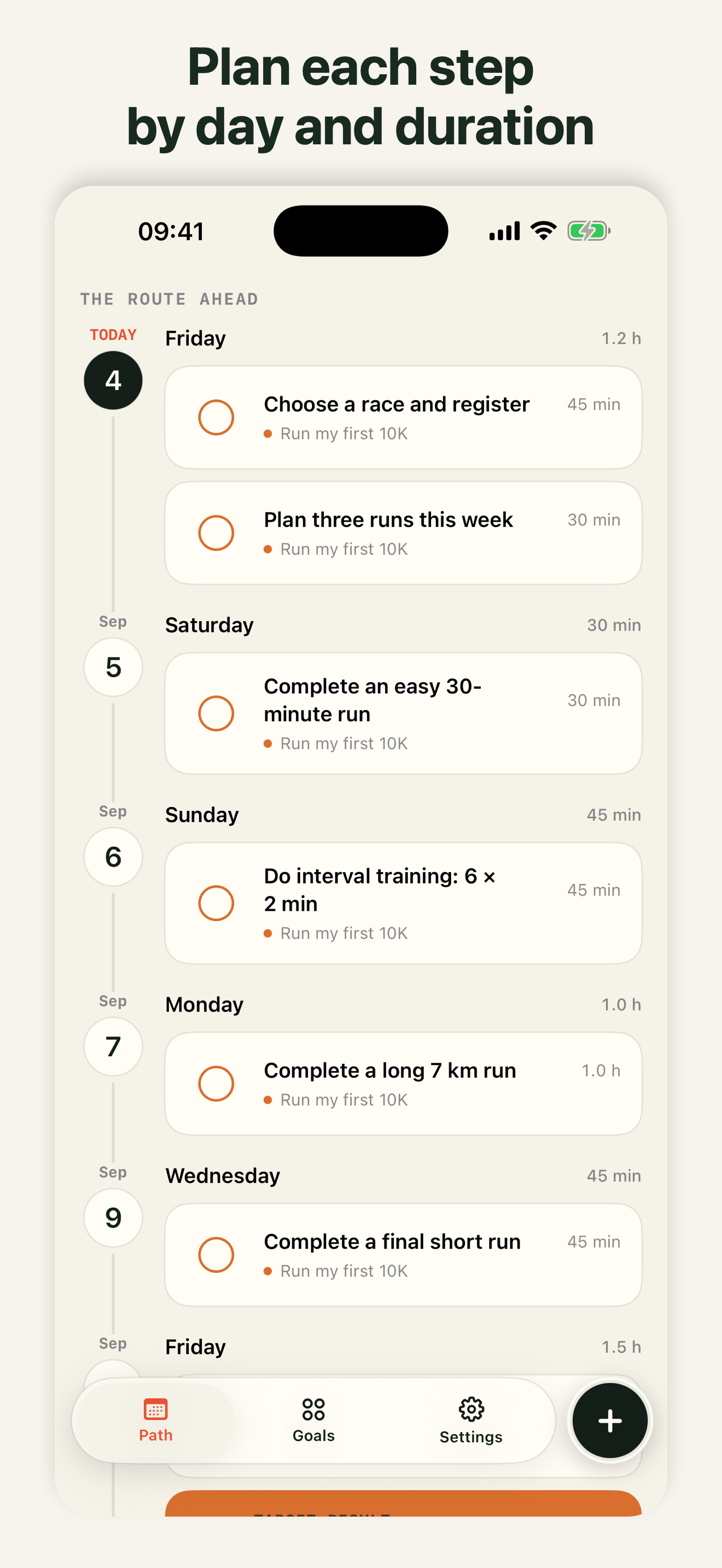
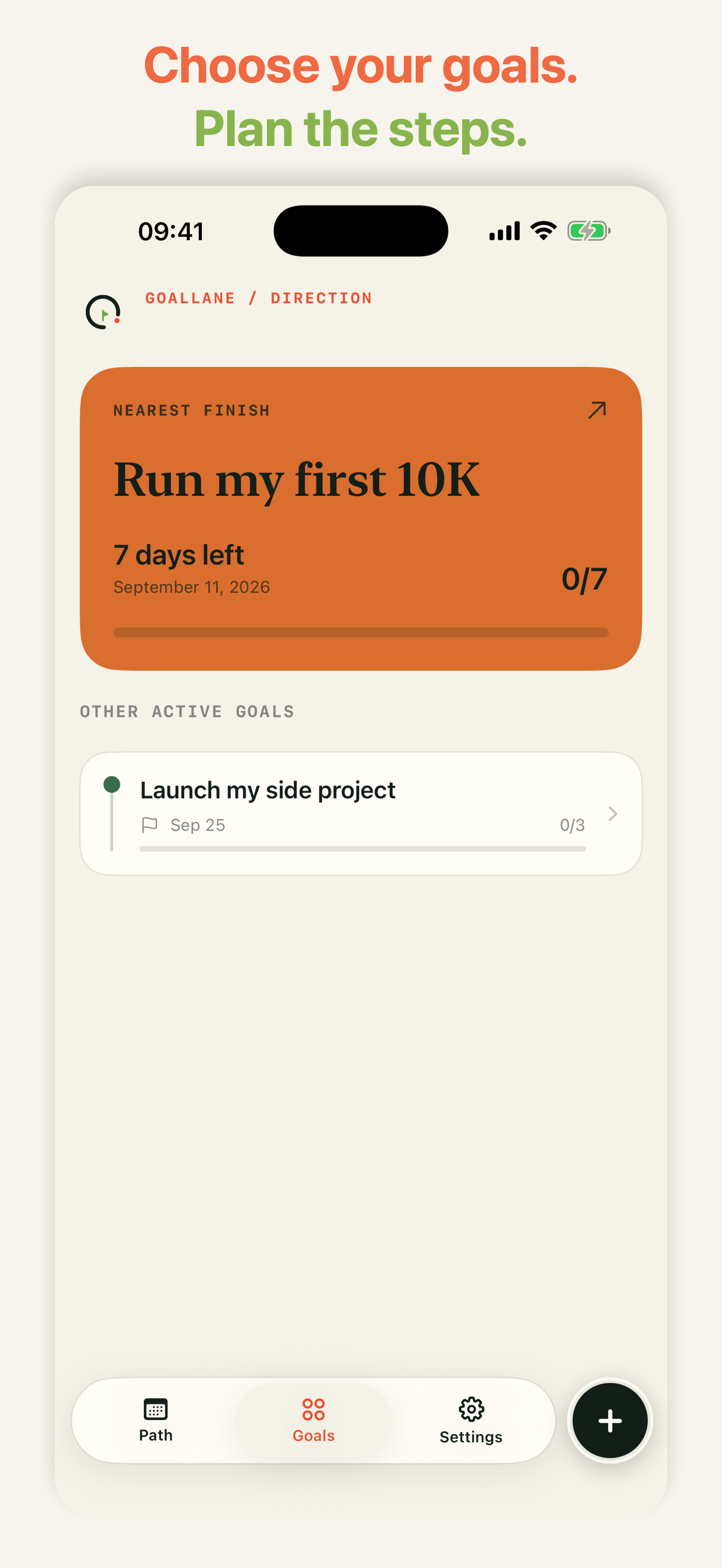
So GoalLane does not begin with an empty task inbox. It begins with a result. A task belongs to a goal, and the goal has a finish date. When I look at today’s steps, I can still see why each one is there. If a task does not lead toward the result, perhaps it belongs in a different tool - or perhaps it does not need doing now.
I Cannot Plan My Whole Life, but I Can Plan Two Weeks
I have things I would like to achieve by the time I am 45. I can describe their direction, but I cannot honestly draw every step between here and that birthday. I do have a better chance of deciding what meaningful, limited result I can reach next.
For example, “build a website someday” is an aspiration. “Publish a four-page personal site with a working contact form by the end of the month” gives me a finish line I can recognize. Writing the pages, testing the form, and deploying the site become steps toward it. They are not a guarantee of a larger career outcome; they are a small, observable part of the route.
That is the scale I want GoalLane to hold: days and weeks, usually a fortnight or a month. It suits a world in which plans can change quickly. Living in Ukraine has made uncertainty impossible for me to treat as an abstract productivity problem, and instability is hardly confined to one country. A short horizon does not make circumstances predictable. It makes a plan easier to revisit without pretending I control years I cannot see.
A Goal Needs an Ending, Not Just a Nice Name
I ask for a result, a date, and a description of what “done” means. Think of it as a small, measurable, time-bound goal in the spirit of SMART, not a form to fill out for its own sake. The aim is a specific, observable outcome: not “get healthier,” but perhaps “complete a particular event”; not “work on my portfolio,” but “publish the first usable version.” A person can change the plan as they learn more. The finish line is there to make the next choice clearer, not to turn a missed date into a moral failure.
Research offers a useful distinction here. Edwin A. Locke and Gary P. Latham’s review, “Building a Practically Useful Theory of Goal Setting and Task Motivation: A 35-Year Odyssey” (American Psychologist, 57(9), 2002, pp. 705-717), found that specific, challenging goals can outperform vague instructions to “do your best,” with important qualifications around ability, commitment, feedback, and the kind of task. Peter M. Gollwitzer and Paschal Sheeran’s “Implementation Intentions and Goal Achievement: A Meta-Analysis of Effects and Processes” (Advances in Experimental Social Psychology, vol. 38, 2006, pp. 69-119) concerns the value of deciding when and how to act, rather than relying on intention alone.
Those studies did not test GoalLane. Nor do they establish that two weeks or three goals is a universal optimum. I take a modest product lesson from them: a named outcome and a workable plan give action more structure than a vague wish.
Three Goals Are a Suggestion, Not a Command
Attention has limits, even when ambition does not. GoalLane suggests keeping no more than three active goals at once. That is a design choice, not a scientific law or a judgment about anyone’s capacity. If it does not fit your life, you can change the limit.
There is a second limit that matters even more: time. During setup, GoalLane asks how much time you can really spend on your goals in a day. The steps have estimated durations, so the day’s plan can show when it exceeds that capacity. If I have 45 minutes, filling the day with three hours of promising-looking cards will not create two extra hours. It will only create a plan I cannot keep.
I would rather see that conflict while planning than discover it at night. A smaller route that fits real life is more useful than an impressive route that exists only on a screen.
Milestones, Not Another Place for Every Errand
The steps in GoalLane are the milestones I want to reach on particular days. If a step needs breaking down into five tiny actions, I am happy to use a paper notebook, Apple Reminders, or Todoist for that detail. At work, Jira has its place. None of those tools is a rival to the question GoalLane is meant to answer: What result will today move me toward?
My hoped-for ritual is light. Set a short goal, sketch the route, and check in perhaps once a day to see the next steps or adjust the plan. There is no need to narrate every hour of life to an app. A missed day is information: maybe the estimate was wrong, maybe the day changed, maybe the goal needs another route.
The exercise matters more than the software. Regularly naming a result and laying out a few milestones is my answer to the pattern of doing a lot and getting little from it. It makes it harder for a busy day to masquerade as progress - and easier to notice when a small step really did move the goal forward.
Private by Default, with Room to Grow
Goals can be intimate. I would not want a developer I have never met to store my plans for my health, relationships, work, or future. GoalLane therefore works on the iPhone without an app account, a developer-owned server, advertising, or analytics. Local storage is the default. If you choose iCloud, the app can instead use a private database tied to your Apple Account; that is an explicit choice involving Apple’s infrastructure, not a claim that data never leaves the device. You can also export a JSON backup.
Today GoalLane is an iPhone app. I would like to make iPad and macOS versions for people who want their goals across their own devices through iCloud, but those versions do not exist yet and I am not promising a release date.
GoalLane is not a life coach and not a machine for squeezing more out of every day. It is a private place to choose a nearby finish line, be honest about the time available, and see the steps between here and there. If the day has a direction, doing less can finally mean moving further.
There is more about the app on the GoalLane product page at m09.org.
Continue exploring
Related reading

Search Clues: My First Pass at an Organic Traffic Drop
A practical, private first pass at falling organic traffic: export Search Console data, compare confirmed Google updates and site changes, and keep several sites' history in your own browser.

Why I Built Joys & Woes: A Private Place for the Days We Forget
The personal ritual behind Joys & Woes, and why I built this iPhone journal to be local-first, private, exportable, and useful without sharing your life online.