Article · 10 minutes
The Nonfiction Reading Process I'm Testing With NotebookLM
A nonfiction reading process I am testing: fewer interruptions while reading, my own recall first, and NotebookLM to check the book afterward.

Books are important to me. I read on a screen, read paper books, and listen to some through ElevenReader. But I have never wanted the act of reading to become a clerical job: highlight a sentence, sort it into a folder, tag it, and hope I can find it again.
At first I thought the problem was capture: how do I bring e-book highlights, pencil marks in a paper book, and thoughts from an audiobook into one place? But every solution I imagined would add work at exactly the moment I wanted to read. I might end up with an archive of fragments, not a better understanding of the book.
So I am testing a different approach: leave reading mostly alone, speak briefly from memory when I finish, and only then use NotebookLM to check my recollection against the text. I want to see whether that leaves me with something more useful than a pile of highlights: a clearer view of the author’s argument and where it meets my own life or work.
This is for nonfiction: business books, research-based books, popular science, and other books that make claims about the world. A novel asks for a different kind of attention.
The problem with collecting highlights
A highlight records what looked important at the moment. It does not tell me what I understood, what I disagree with, or why the passage might matter next month. With a paper book, moving those marks into a digital archive is work. With audio, it is even less natural.
So I am not designing this process around perfect capture. I create one notebook for each book in NotebookLM and, when I have a usable electronic edition, add the book as the source. EPUB can be uploaded directly; it does not need to become Markdown first. If I read in print or listen, the electronic edition is my reference text.
The book is the evidence. My memory is a separate thing. The point is to bring them together after I have had a chance to think.
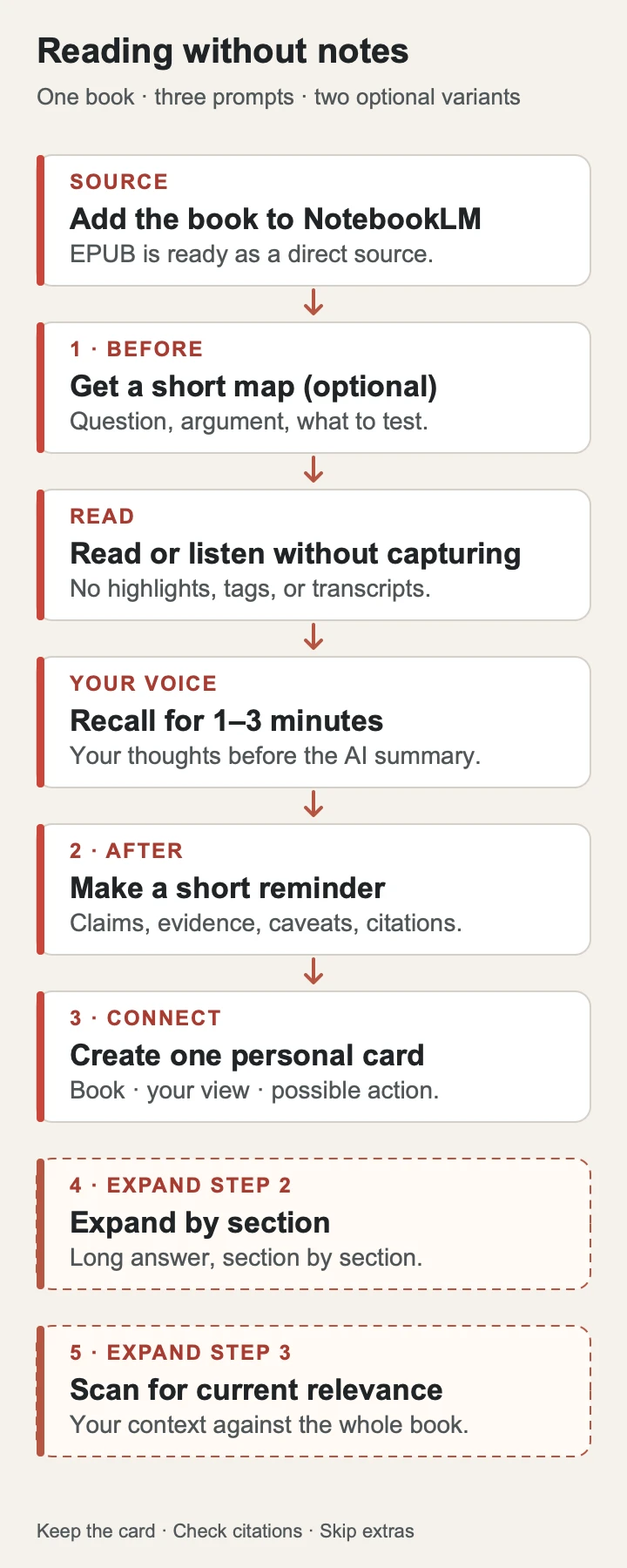
This is not a five-step obligation. The preview is optional; steps 4 and 5 are deeper alternatives to steps 2 and 3. The part I care about most is recalling the book myself before I read a polished summary.
1. A short map before reading
I do not need a detailed summary before opening the book. That would turn discovery into recognition: instead of following the author, I would merely look for points I have already been told to expect. I ask for a map of the question, the argument, and a couple of things to test while reading. This step is optional.
Here I leave NotebookLM’s response length at its default setting. I am still playing with the length setting, but before reading I only want a short map; I switch to a longer response for steps 4 and 5.
I have not read this nonfiction book yet. Use only the selected book.

Give me an orientation of no more than 180 words:
1. What question or problem is the author addressing?
2. What is the central position? If there is no single thesis, do not invent one.
3. What 3–5 themes or stages of the argument lie ahead?
4. What two questions should I keep in mind while reading, including one about how well the conclusions are supported?

Do not reveal detailed conclusions, evidence, or examples. Separate the author's position from established facts. Cite the relevant passages for the central position and map. Do not add external information.
Then I read or listen. I do not have to highlight, photograph pages, or stop an audiobook to dictate a note. For a long, dense book, I might record a minute of my own recap after a major part, but that is an option, not a requirement.
The small pause that matters most
When I finish, I record one to three minutes of my own thoughts before asking NotebookLM for its summary. What do I remember? What do I doubt? What connects to something I am doing now? I have a Plaud NotePin S for quick voice notes. I can record the recap on it and use the transcript later, or dictate directly into a private note on my phone without editing.
I keep that recording or text outside the NotebookLM chat at first. If I ask for an AI-generated summary first, it becomes harder to see which ideas were mine. This is not a memory exam. It is a way to leave a trace of my own reading before a polished answer reshapes it.
2. A reminder after reading
Now I select only the book as a source and ask for a compact account I can return to later. I want the author’s reasoning, not a list of attractive quotes.
Create a reminder of no more than 500 words from the selected book. Use only that book as a source.

Show:
1. The main question and the author's position. Preserve ambiguity if the book presents several positions.
2. The path of the argument: how the author moves from the initial problem to the conclusions.
3. Up to five important claims. For each, give the claim, the support the author offers (data, study, example, or reasoning), a material caveat, and a citation to the relevant passage.
4. Three short questions I can use later to test what I remember.

Do not force the book into this template where an element is absent. Do not confuse "the author argues" with "this has been independently established." Do not add outside facts or invent citations.
This is deliberately shorter than a full set of notes. If a claim matters, I can follow its citation back to the source. If it does not matter, I do not need to keep a page of extra prose just because the model can produce it.
3. The part the book cannot write for me
Only now do I paste the dictated text of my own recall. This prompt asks NotebookLM to distinguish three different things: the author’s words, my interpretation, and a possible application. That boundary is more useful to me than a generic section called “key takeaways.”
Replace [MY THOUGHTS] with your own recap. If it mentions work, broad context is enough; there is no reason to add confidential details.
Here is what I remember and thought after reading:

[MY THOUGHTS]

Compare my account with the selected book. Keep three things clearly separate:
- what the book actually says, with a citation;
- what is my own interpretation, experience, or possible memory error;
- what is your hypothesis about applying an idea.

Make one final card of no more than 350 words:
1. The book in up to five important claims, with citations.
2. What I took from it, and where my recollection differs from the text, if it does.
3. One or two useful connections to the experience I described. Do not invent facts about me.
4. A decision: "remember only", "return when relevant", or "test in practice". For a test, suggest one small experiment: where to do what, and what result to watch. Do not force an action where none is warranted.
5. One question I can answer from memory later, before rereading the card.

If my context is too thin for a meaningful connection, ask up to two precise questions and wait for my answer instead of giving generic advice.
I keep this card as the durable result. I do not need to preserve every intermediate response.
4. When a short reminder is not enough
The second step has a longer variant. If the book is a reference I expect to revisit, I set NotebookLM’s response length to longer and ask for a section-by-section account. That does not guarantee every chapter will fit into one answer, so I compare the output with the table of contents.
Create a detailed summary of the selected nonfiction book. Use only the book. Follow its actual structure: parts and chapters, or other major sections if that is how it is organized. Do not invent section titles or order.

First, show the book's structure briefly. Then, for each major section, explain:
1. What question does it address, and what role does it play in the overall argument?
2. What are its main claims, and how does the author support them: data, studies, examples, or reasoning?
3. Which terms, caveats, conditions, or objections matter?
4. How does it connect to the next section, if there is one?

Cite the book for important claims. Do not repeat an idea merely to make the answer longer or bring in outside facts. Distinguish the author's claims from independently established findings. If the answer cannot fit every section, stop at a section boundary, list the sections not yet covered, and continue from the first of them when I say "Continue", without repeating earlier sections.
If it stops early, I use: Continue with the first section not yet covered. Keep the same format and do not repeat earlier sections.
5. When I want to connect the whole book to current work
The third step begins with what stayed with me. That is valuable, but it can miss a useful idea elsewhere in the book. For this optional variation, I set NotebookLM’s response length to longer and ask it to search the whole source against my present situation. I still check its coverage against the table of contents when completeness matters. The variables below are intentionally blank: they are not a biography, and no one else needs to expose private project details to use the prompt.
Before sending it, I replace [MY ROLE], [CURRENT PROJECTS OR NICHES], [WHAT I AM TRYING TO IMPROVE], [BUSINESS OR PERSONAL GOALS], and [CONSTRAINTS]. I still select only the book as a source.
Help me assess the practical value of the selected book for my current context. Use only the book and the context below. Examine the whole book, not just topics we have already discussed.

My context:
- Role and experience: [MY ROLE]
- Current projects, products, or niches: [CURRENT PROJECTS OR NICHES]
- Decisions or skills I am trying to improve: [WHAT I AM TRYING TO IMPROVE]
- Business or personal goals: [BUSINESS OR PERSONAL GOALS]
- Constraints, resources, and information I cannot share: [CONSTRAINTS]

Find no more than five ideas from the book that are most useful in this context. For each:
1. State what the book actually says, with a citation.
2. Explain where the idea might help in my work or decisions.
3. Say why the connection is reasonable, and where it becomes your hypothesis or a transfer into a new field.
4. Suggest a change in thinking, a decision, a workflow adjustment, or a small test. Say so if no action is needed.
5. Explain when the idea might fail or what evidence I would need to check it.

Choose one idea with the greatest potential value now and explain why. Do not add generic advice that is not in the book or pretend that the author wrote about my industry if they did not. If there is no direct relevance, say so and mention only plausible indirect connections. If my context is insufficient, ask no more than three clarifying questions before answering.
What I keep after the chat
I save the answers I want to revisit as Notes right inside NotebookLM: the short reminder, the final card, and the longer versions when I use them. Then I clear the chat. It is easier for me to work when a new question is not buried in an old conversation, and I can return to the saved Notes whenever I need them.
A source citation is not a truth certificate
NotebookLM helps me return to a passage. It does not prove that the passage is correct, that an author interpreted a study fairly, or that an idea transfers to my business. It can also misunderstand a source. For the one or two claims that are surprising or important, I open the cited text myself. When a scientific or business claim has real consequences, checking it against independent evidence is a separate job.
I am still testing this ritual. Its attraction is not that it turns every book into a productivity asset. It lets me read without running a parallel filing system, then spend a few minutes deciding what, if anything, is worth carrying forward.